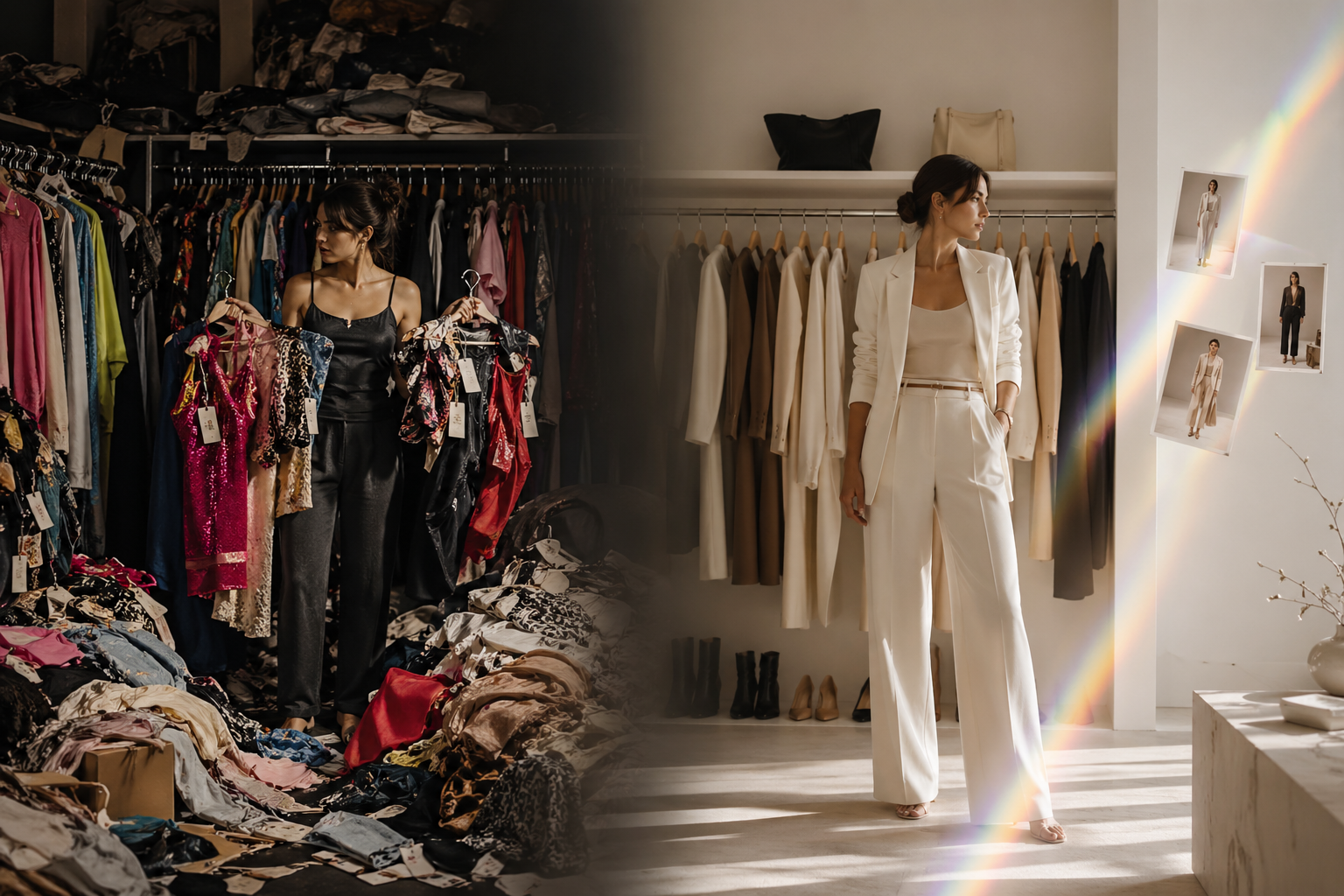
There's a slogan reshaping how people buy clothes:
It sounds aspirational. Limitless. Effortless. But what it really promotes is something else:
- Buy more
- Think less
- Optimize for price, not outcome
- Treat clothing as disposable
The question that actually matters
Fashion has trained us to think in one direction: "How much can I buy?"
But that's the wrong metric. The better question is: "How much of what I buy do I actually wear?"
Because that's where value lives. Not in ownership.
In usage.Why you have nothing to wear
You probably already own enough clothes.
But your daily reality still looks like: trying multiple outfits, second-guessing combinations, wearing the same 20% of your wardrobe — and ignoring the rest.
This isn't a style problem. It's a wardrobe system problem.
of the clothes people own are rarely or never worn.
More clothes ≠ more outfits
Here's the hidden truth:
"More clothes often lead to fewer usable outfits."
Why? Because most pieces are bought in isolation — based on trends, based on discounts, based on how they look alone. Not based on how they work with what you already own.
Introducing outfit yield
This is the missing metric in fashion.
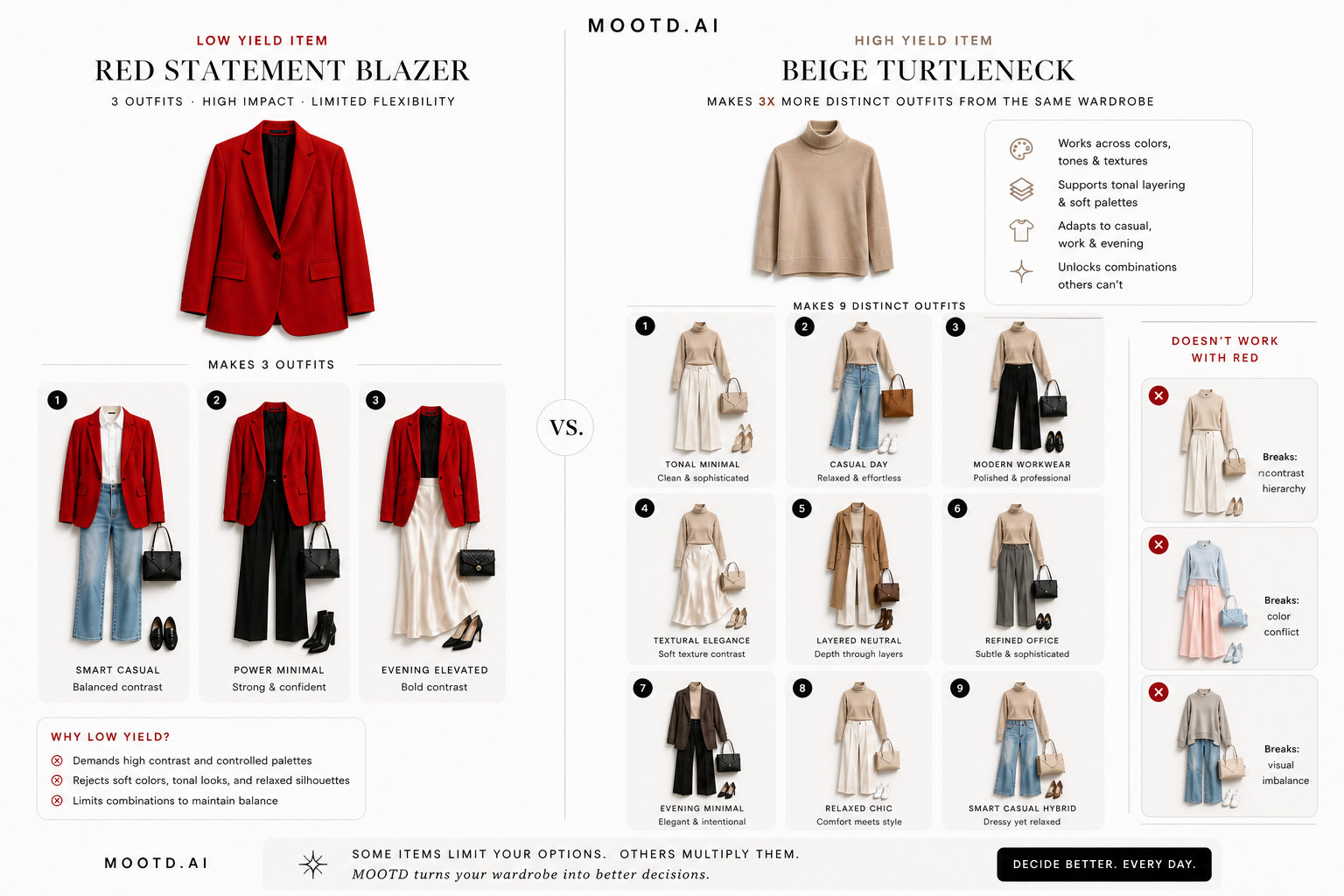 3 outfits vs. 9 outfits. Same wardrobe. Different piece.
Visual: MOOTD.AI
3 outfits vs. 9 outfits. Same wardrobe. Different piece.
Visual: MOOTD.AI
- Easy to combine
- Work across multiple contexts
- Get worn often
- Usually more neutral
Think: well-cut trousers, versatile blazers, quality basics.
Worn often- Harder to combine
- More context-specific
- Worn less frequently
- Often bold or trend-driven
Think: statement jackets, unique prints, standout footwear.
Worn with intentThe real challenge: balance
This is where it gets interesting.
You don't want a wardrobe that's all basics — predictable, forgettable. And you don't want one that's all statement — chaotic, unwearable.
The challenge isn't avoiding mistakes. It's learning how to balance pieces that make your wardrobe work and pieces that make your wardrobe you.
"High-yield pieces give you consistency. Low-yield pieces give you identity."
You need both.
Why cheap fashion breaks your wardrobe
Platforms like Temu win on one thing: volume. More options, lower prices, faster decisions.
But they ignore outfit compatibility, repeat wear, and real-life styling.
So what happens? You buy more clothes but create fewer outfits. Your wardrobe becomes fragmented. Getting dressed gets harder.
The shift people are already making
More people are starting to think differently: focusing on cost per wear instead of price, building capsule wardrobes, choosing fewer and better clothing items, prioritizing versatility over impulse.
Not because it's trendy. Because it works.
Where MOOTD fits
Your wardrobe should produce outfits—not confusion.
Instead of pushing you to buy more, MOOTD helps you turn your existing wardrobe into real outfits, increase how much you actually wear, and balance high-yield and statement pieces.
It helps you identify real gaps — not imagined ones.
And only then suggest what to buy — with purpose.
Your wardrobe should produce outfits — not confusion.
MOOTD helps you see what your wardrobe can actually do — before you buy a single new thing.
Join the waitlistThe real meaning of dressing like a billionaire
It's not about buying endlessly. It's about control. Knowing what works, wearing what you own, making fewer and better decisions, having a wardrobe that delivers every day.
So the question changes.
The future of fashion isn't more. It's smarter. From buying to wearing. From quantity to utility. From randomness to system.
Because in the end:
"A great wardrobe isn't the one with the most clothes.
It's the one you actually wear."