1. The Closet of Infinite Chaos
Welcome to the "Narnia" of the Anthropocene: your closet. It is a mystical realm where hangers fight for oxygen, and half-forgotten fast-fashion trends go to rot in a dark corner of purgatory. We’ve all been there—staring into a tectonic plate of last-season’s mistakes, late for a meeting, declaring to the heavens that you have "absolutely nothing to wear" despite owning enough cheap polyester to carpet a mid-sized stadium.
This isn’t just a "morning person" struggle; it’s a systemic disaster. Your dependency on $5 blended fabrics has created a wardrobe that is bloated yet useless. But what if the secret to escaping this sartorial suffocation isn't a bigger IKEA dresser, but a "survivalist" strategy based on the number 85? This isn't a restrictive fashion diet intended to make you miserable; it’s a decision-paralysis-busting blueprint for a four-season climate. Having less actually gives you the one thing your overstuffed closet denies you: a curated choice.
Before you dismiss this as minimalist fan fiction, let’s look at the cold, hard science. As it turns out, your closet is the front line of a global ecological siege.
2. The 85-Item Architecture: How 85 Pieces Master Four Seasons
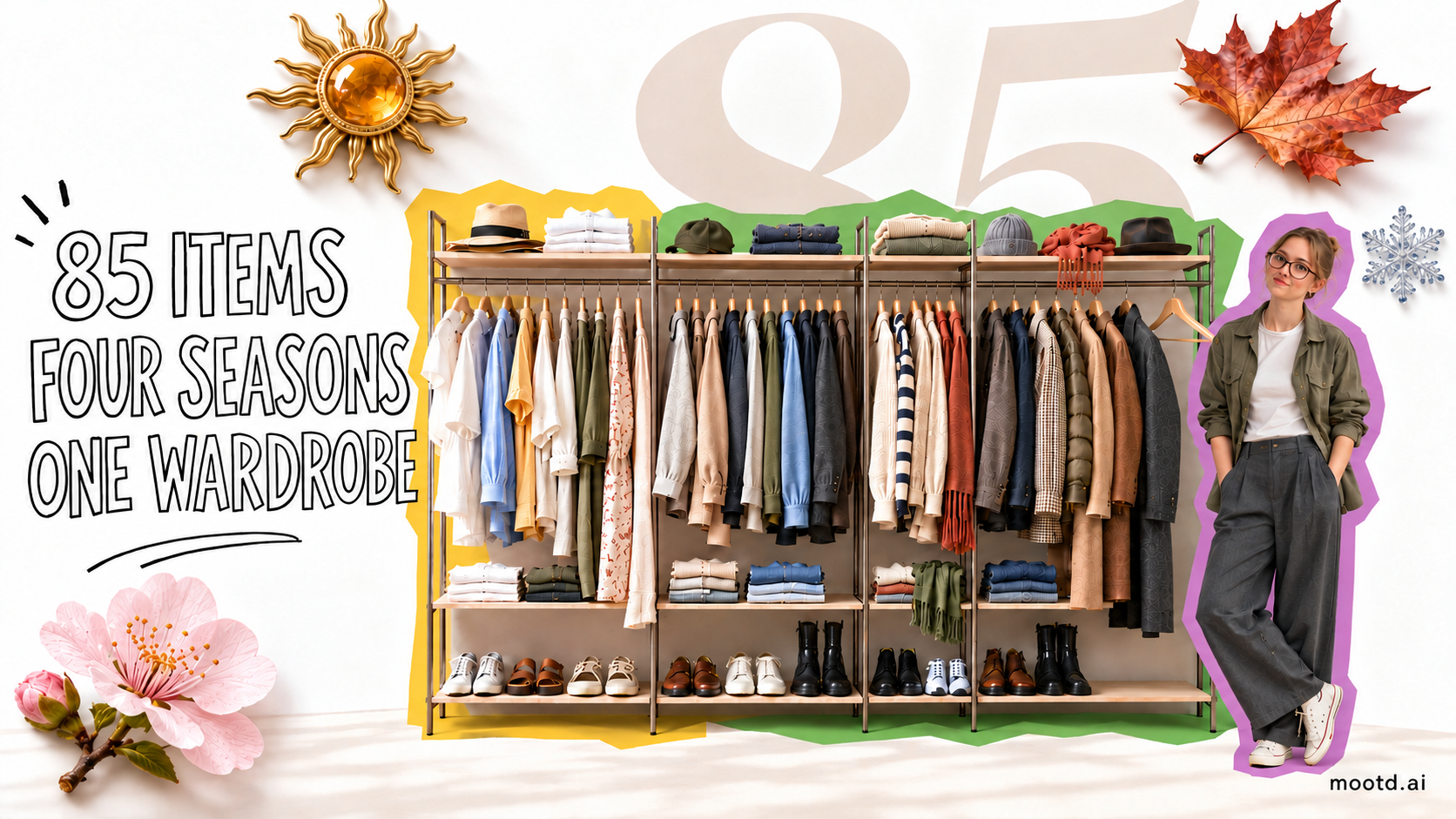
The Hot or Cool Institute’s 2022 report uses 85 garments, including shoes, as a sufficiency reference for a four-season climate. It describes average needs, not a universal optimum or a guarantee that a wardrobe meets climate targets. Your work, health, laundry routine and local weather still matter. [1]
Now, if you live somewhere with four distinct seasons, surviving temperatures ranging from scorching summer heatwaves to sub-zero winter blizzards on 85 items might sound like a recipe for frostbite. But the secret isn't owning more clothes—it’s intelligent category allocation through a few practical principles:
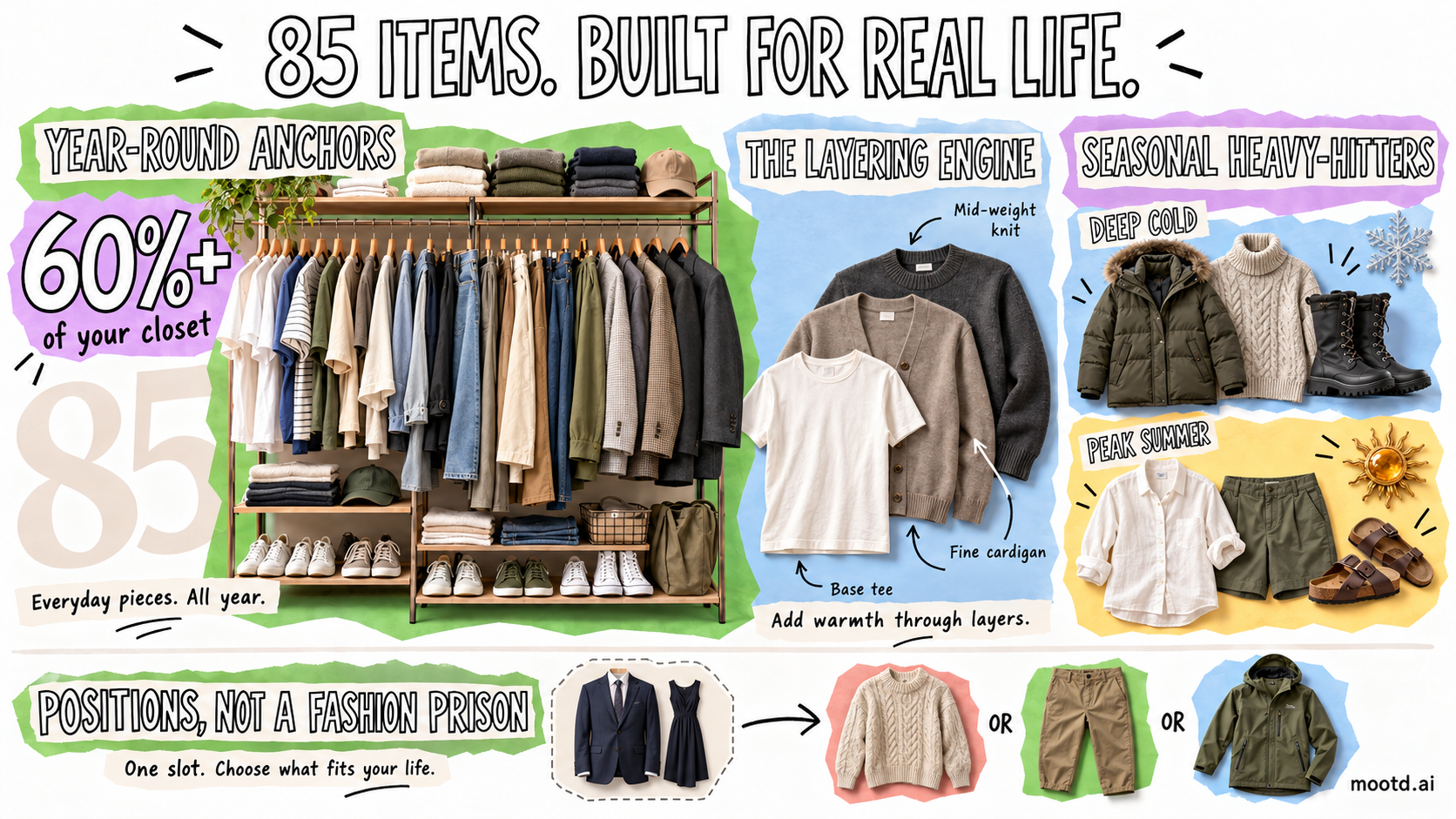
- The Year-Round Anchors: Everyday jeans, casual trousers, short/long-sleeved tops, blazers, and classic sneakers that earn their place across more than one season. The illustration’s 60%+ is a planning suggestion, not a research requirement.
- The Thermal Layering Engine: Rather than stuffing your closet with 15 bulky coats, the 85-item framework relies on smart layering—base-layer tees, fine-gauge cardigans, and mid-weight sweaters that stack effortlessly as the temperature drops.
- Seasonal Heavy-Hitters: Dedicated, high-impact slots reserved strictly for climate extremes—insulated winter coats, weatherproof snow/rain boots, and heavy knits for deep freezes, alongside linen shirts, tailored shorts, and breathable sandals for peak summer.
- Positions, Not a Fashion Prison: Every item represents a functional "slot" or "position". If your job doesn't require formal suits or dresses, those slots automatically shift into extra warm knitwear, casual trousers, or outdoor jackets.
3. The Helping Lists: A Blueprint for the Bold
How do you actually distribute these 85 items? The goal is “closet architecture”—a collection that works for your real life, not the fantasy life where you attend three galas a week and actually go to that 5 AM Pilates class.
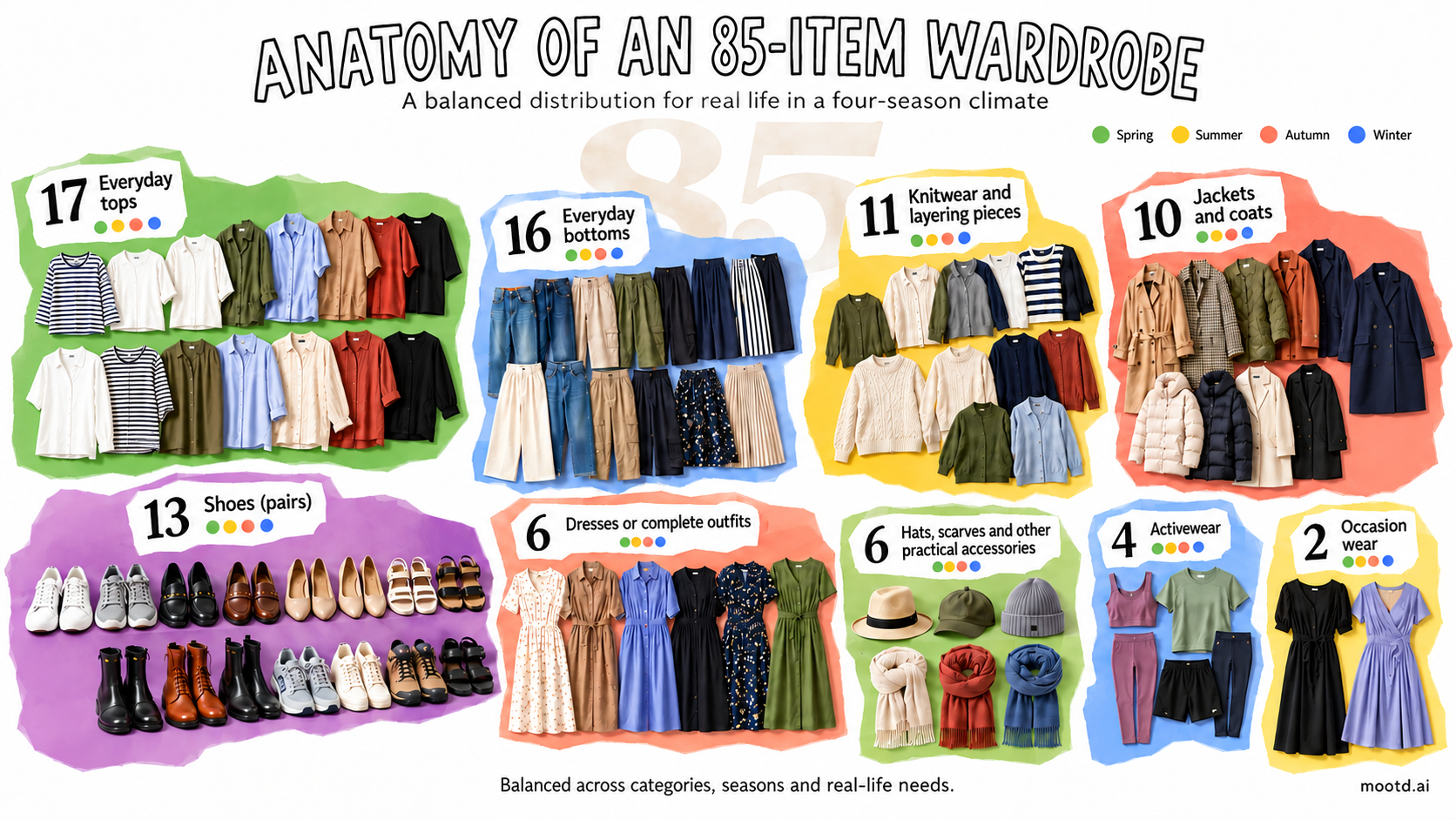
The illustration below offers MOOTD’s example allocation. It is a practical interpretation, rather than the institute’s prescribed list. It includes six practical accessories within its 85 slots; that is our own counting convention.
- Everyday tops: 17
- Everyday bottoms: 16
- Dresses or complete outfits: 6
- Knitwear and layering pieces: 11
- Jackets and coats: 10
- Activewear: 4
- Occasion wear: 2
- Shoes: 13 pairs (one pair counts as one wardrobe item)
- Hats, scarves and other practical accessories: 6
Total: 85. Winter clothing is already included in the categories. Underwear and socks are outside this example. Count each item once, even if it does several jobs.
If you do not wear dresses, move those slots to categories you use. If you cycle to work or train daily, your activewear needs will differ. Nobody’s laundry schedule should require an apology to a spreadsheet.
The North Star: Tiffanie Darke and the Rule of Five
If we want to navigate the transition to a sustainable closet without losing our personal identity, we have to look at the math. Enter Tiffanie Darke’s "Rule of Five" campaign.
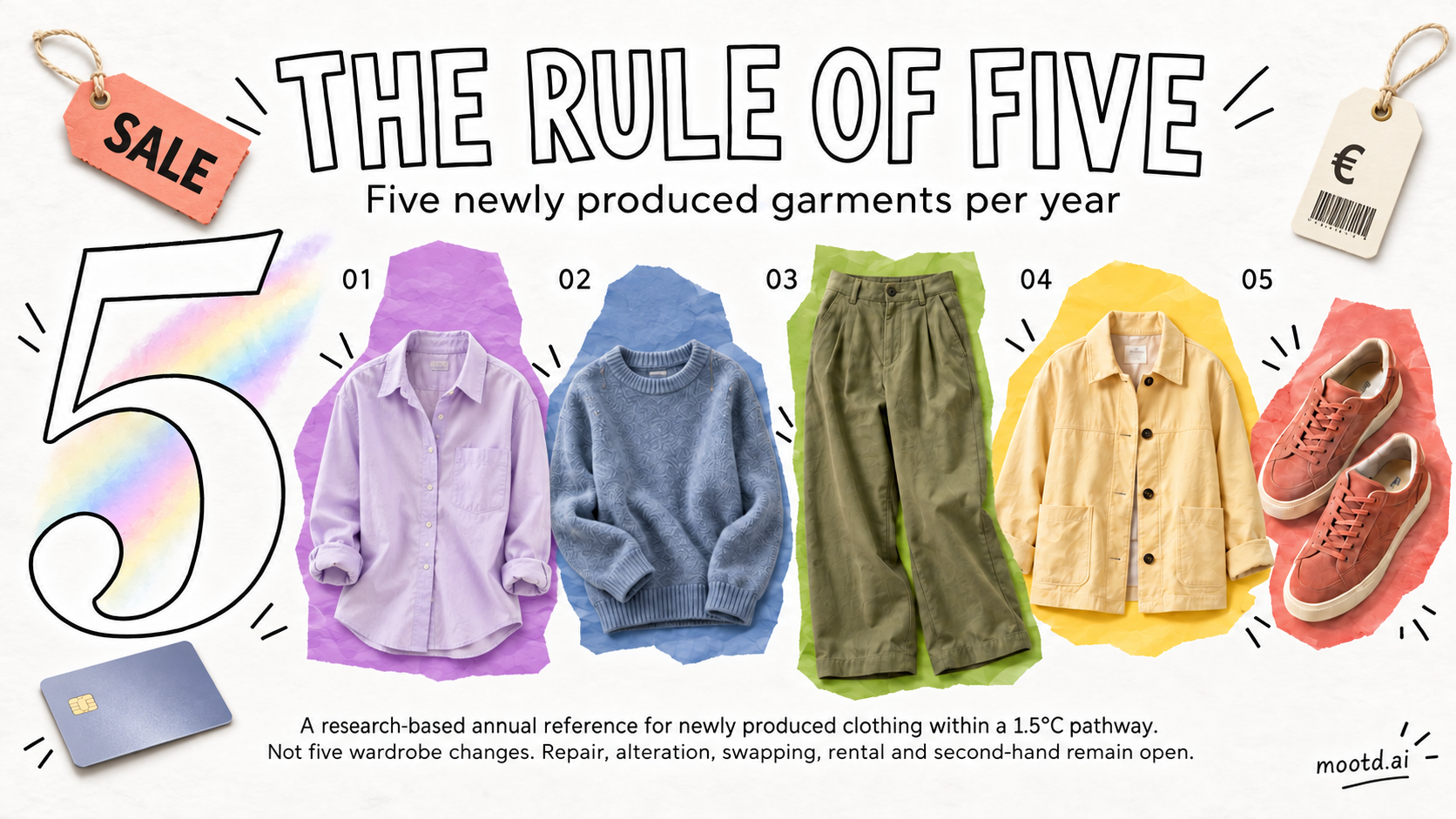
The campaign asks you to limit new fashion purchases to five a year. It draws on Hot or Cool’s consumption research; five is a reference from its climate modelling, not a promise that an individual shopping limit alone keeps warming below 1.5°C. [1]
In her 2026 guidance, Darke counts shoes, accessories and gifts within the five. She allows repairs, alterations, borrowing, swapping and renting, plus a modest secondhand allowance—four items in her own version. [2]
Five purchases make impulse buying a slightly more interesting negotiation. Does the new sweater fill a real gap, or is it applying for a job already held by seven other sweaters?
Reclaiming that pause is how we take the remote back.
Stat Attack! Why Your Closet is Currently "Expensive Wallpaper"
Still feel like you need that sixth new sweater? Let’s look at why your current wardrobe is likely the most underperforming asset in your portfolio. Most closets aren't functional toolkits; they are effectively expensive, textile-based wallpaper.
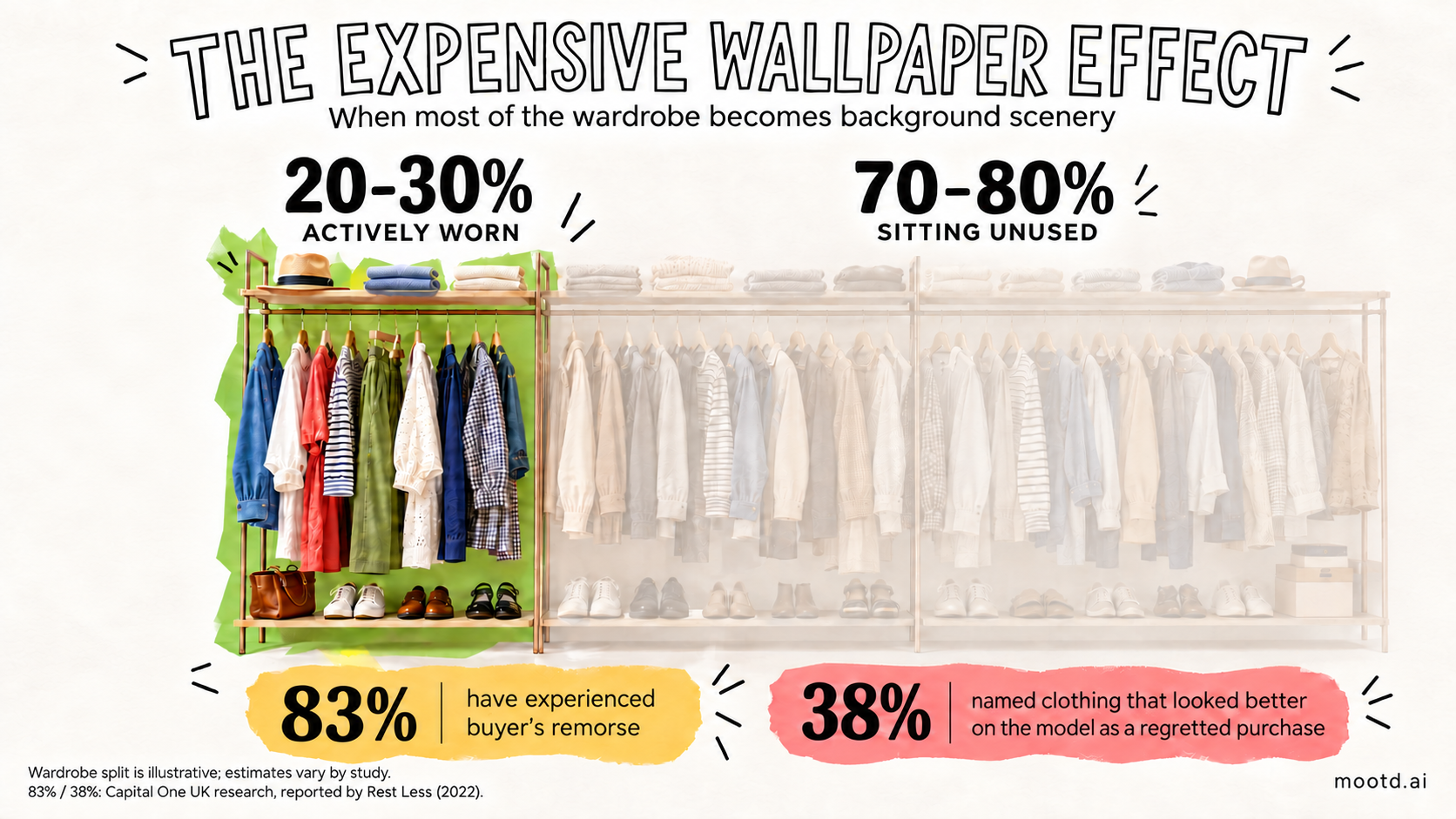
The illustration makes the point visually: a small working rail beside a lot of expensive background scenery. Its 20–30% actively worn / 70–80% unused split is illustrative, not a measured rule for every wardrobe.
The survey figures tell a more specific story. Capital One UK research reported by Rest Less in 2022 found that 83% of respondents had experienced buyer’s remorse after a purchase, while 38% regretted clothes that looked better on the model. Neither figure means that 83% of people buy clothes they never wear. [3]
Your own numbers are more useful than somebody else’s average. Look at what you actually wore over the last season, then check what the rest is waiting for: different weather, a repair, a better fit—or an entirely different life.
Capping new purchases becomes less dramatic when you first discover what you already own. We’re cutting the fluff so we can actually see the hits.
The "Free Pass" Checklist: Expanding Your Options for Free
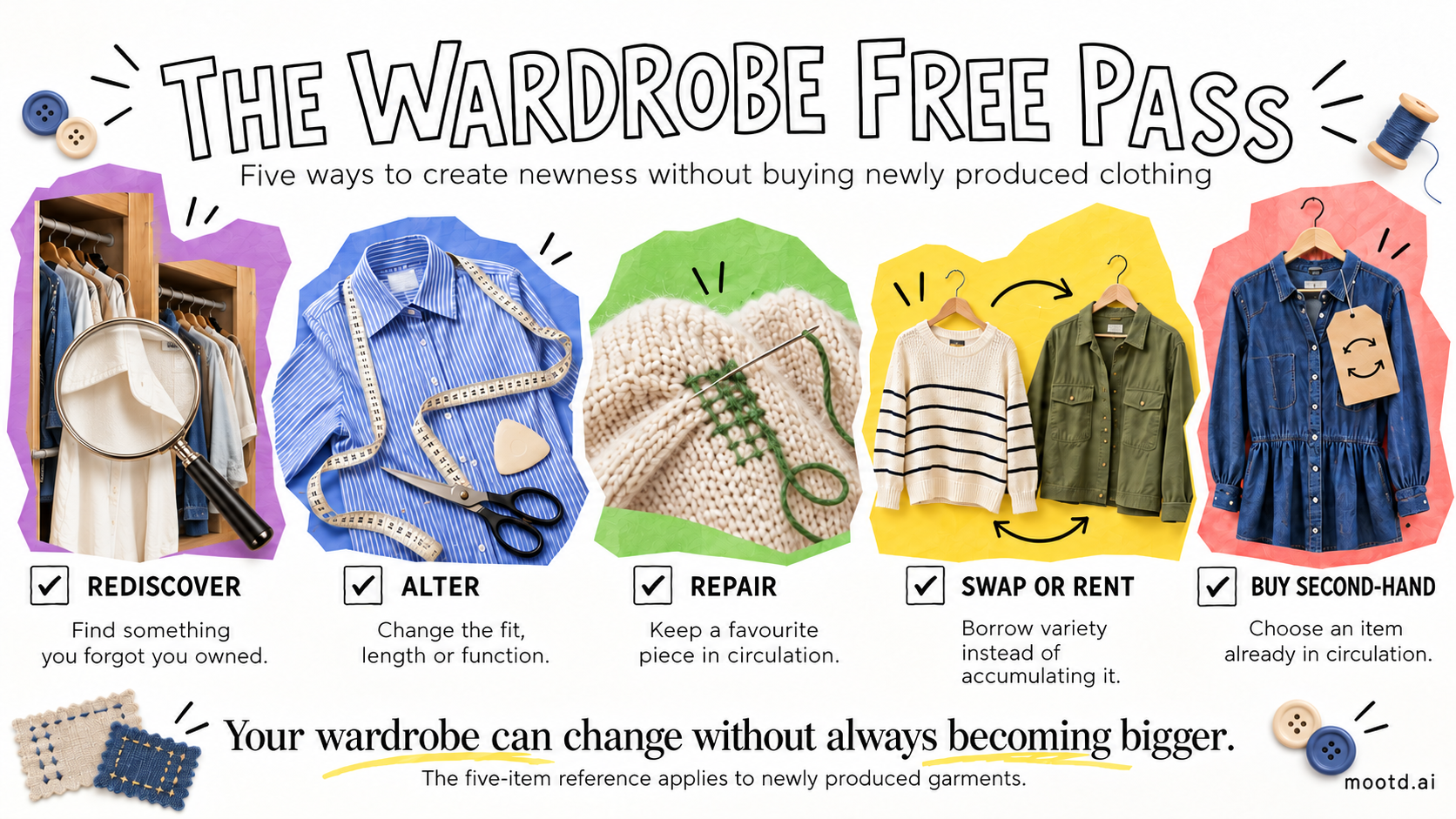
Use this checklist to create variety without buying newly produced clothing:
- “Buying” from your own wardrobe: Dig through storage for the forgotten old.
- Alterations: Ask a tailor to change the fit, length or function of an existing piece.
- Repairs and mending: Keep your favourites alive with a little needle and thread.
- Swapping, borrowing or renting: Find variety without permanently accumulating more.
- Secondhand finds: Choose something already in circulation when you have a real need. Darke’s version includes a limited allowance, not unlimited thrift shopping. [2]
Secondhand is not automatically carbon-neutral: transport, cleaning and whether a purchase replaces new production still matter. The useful principle is to keep clothes working for longer, rather than give overconsumption a vintage label.
By shifting your mindset, you realize that "sufficiency" isn't about having less; it's about making sure what you have actually works.
The Finnish Price Check: The Financial Case for Closet Shopping
Replacing an entire wardrobe with “sustainable” purchases can become another shopping project in very virtuous packaging. Before reaching for your wallet, it helps to ask what people actually mean by sustainable—and what they expect to pay for it.
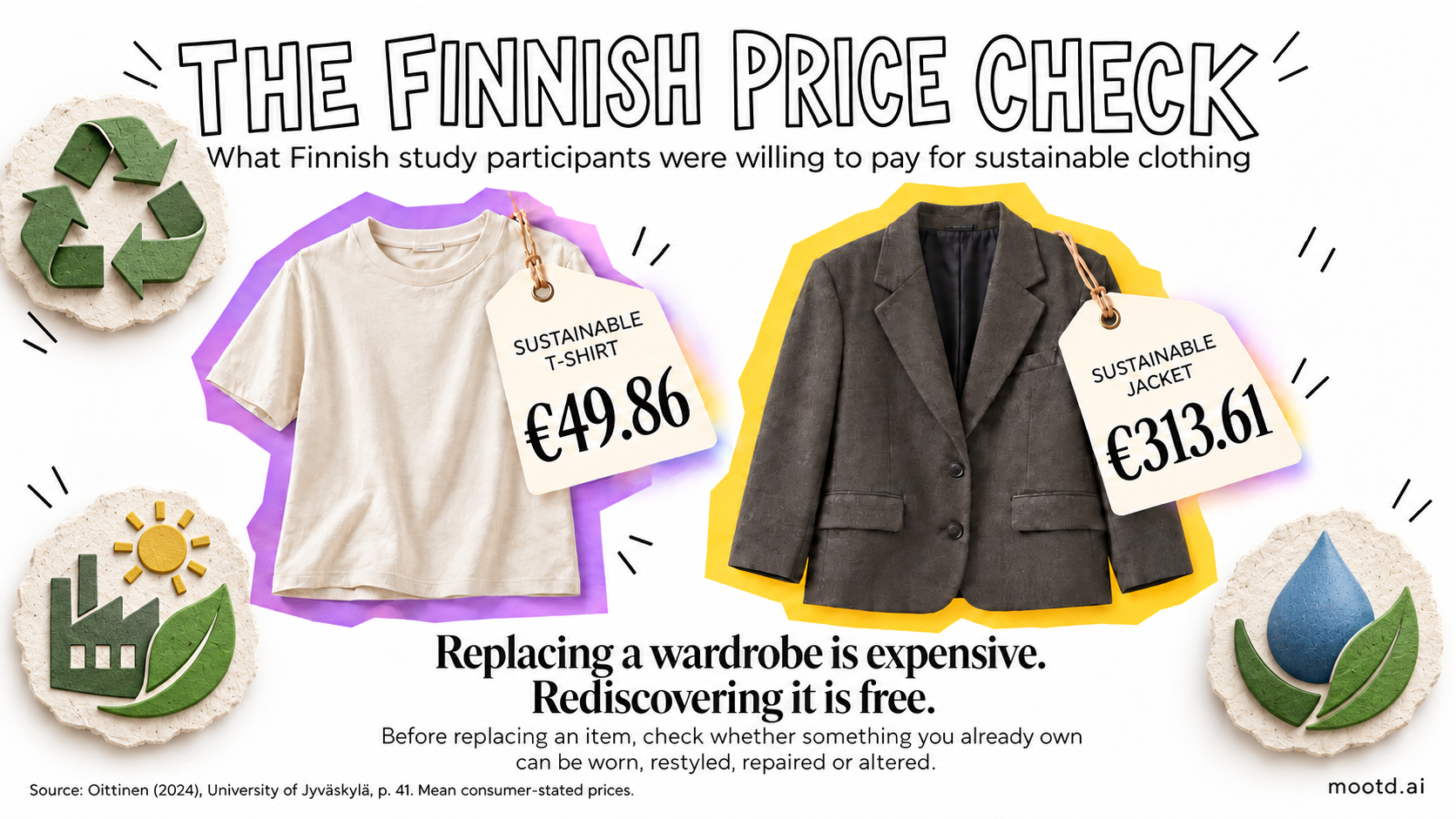
In Tutta Oittinen’s 2024 master’s thesis at the University of Jyväskylä, Finnish participants were asked to state suitable prices for clothing meeting their environmental responsibility expectations. Their average answers were: [4]
- T-shirt: €49.86
- Jacket: €313.61
These are participant-stated prices, not verified retail prices, production costs or proof that a particular garment is ethical. The responses also varied widely.
The practical takeaway still stands: buying replacements is expensive. Rediscovering, repairing or restyling something you already own may meet the need without another purchase. Finding a sweater you forgot about is not literally finding a €100 note—but your next shopping basket might notice the difference.
Conclusion: Active Organization and Beating the Cycle
At its core, the 85-item wardrobe is about active organization, not passive reduction. This isn't a lecture on why you shouldn't have nice things; it's a guide on how to actually enjoy the things you have.
By moving away from the endless accumulation of "disposable" items and focusing on your own personal "textile museum," you reclaim your space and your sanity. You beat the fashion cycle by refusing to be a cog in it. So, go ahead—open that closet, find the pieces you have been overlooking, and start your first guilt-free shopping trip. The best part? You don't even have to put on shoes to do it.
Sources & reading
- Hot or Cool Institute (2022), Unfit, Unfair, Unfashionable — four-season wardrobe reference and consumption modelling.
- Tiffanie Darke, Why I’m Back on Rule of Five for 2026 — campaign rules and secondhand allowance.
- Rest Less (2022), Top 20 purchases shoppers regret the most — reporting Capital One UK research.
- Tutta Oittinen (2024), Perceptions of Environmentally Sustainable Fashion by Finnish 25–45-year-old Consumers — master’s thesis, p. 41.
Turn closet chaos into a clearer picture.
You have met the 85-item idea. Now imagine seeing how your own wardrobe compares—without counting hangers on a Sunday afternoon and losing the will to get dressed.
This is the wardrobe audit we’re building into MOOTD. As you add your pieces, the aim is to make the balance of your wardrobe easier to understand, one category at a time.
- See what you own. Bring the pieces scattered across rails, drawers and “I’ll sort that later” piles into one view.
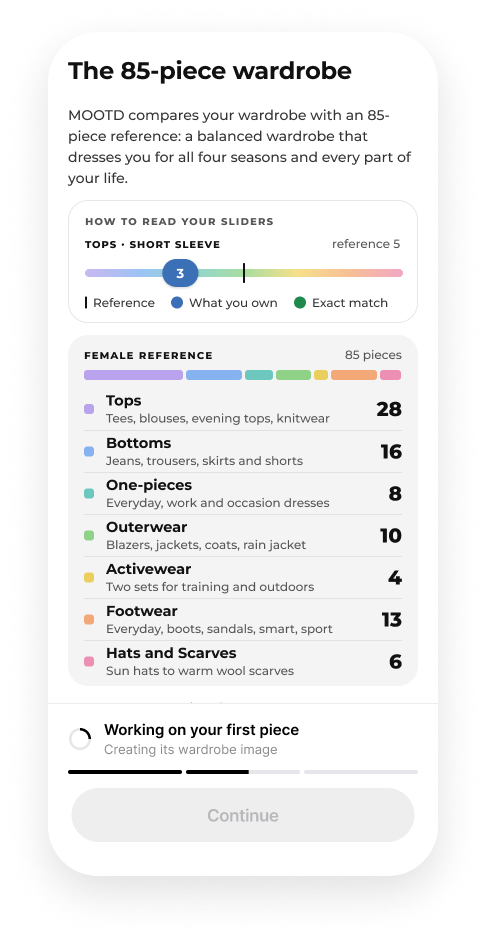
- Put the numbers in context. Compare your category counts with an 85-piece reference, then consider what makes sense for your seasons, routines and style.
- Give your next purchase a reason. Check what you already have before adding another version of the same thing.
The reference is a starting point. An empty slot is a question to consider, not an instruction to go shopping.
Before you buy something new, meet the wardrobe you already have.
Make more of what’s already yours.
Download MOOTD for free for a more considered way of getting dressed—starting with your own wardrobe.
Get the MOOTD app